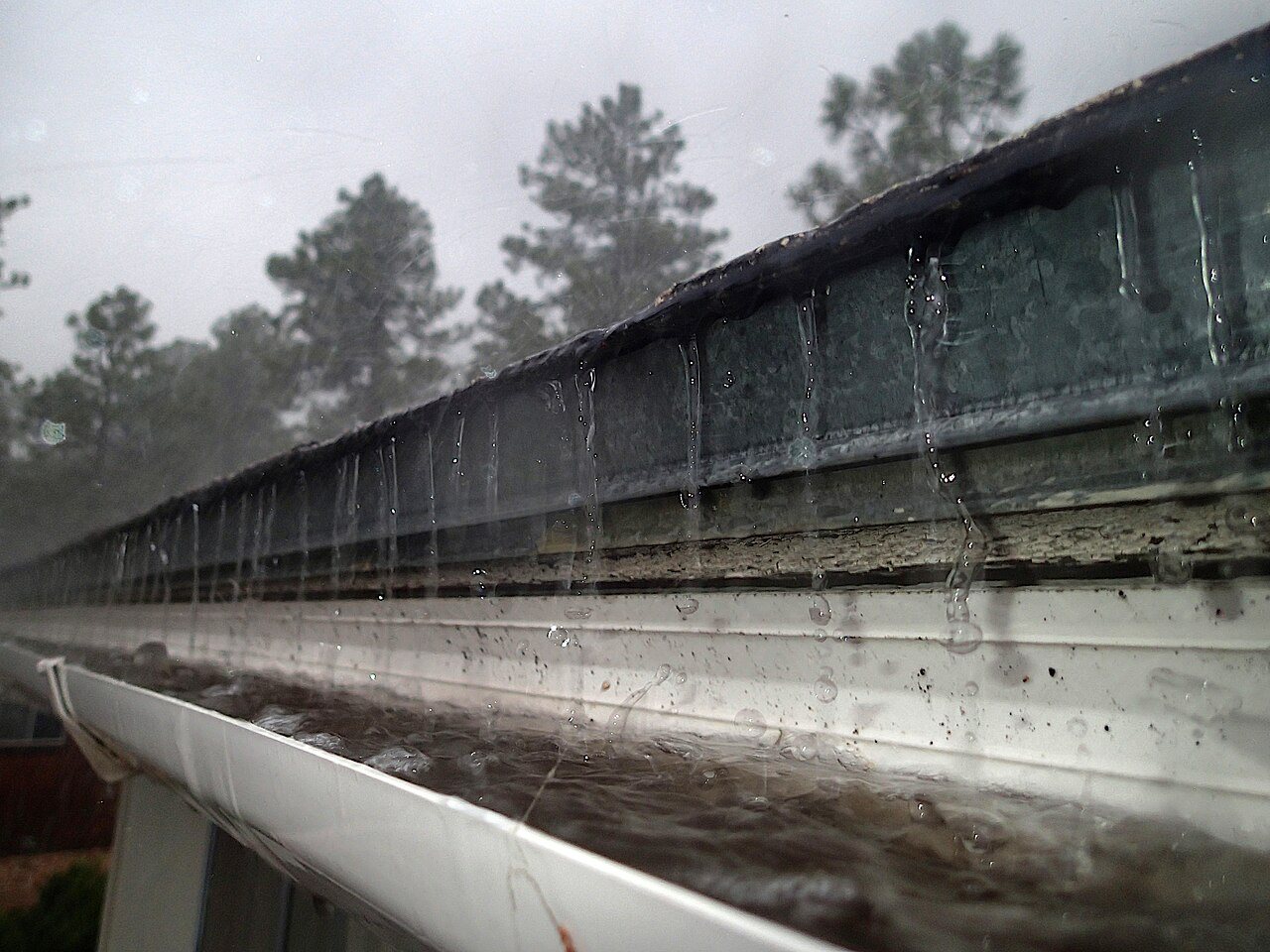
Photo: cogdogblog, CC BY 2.0, via Wikimedia Commons
Nobody has ever looked forward to cleaning gutters. You stand on a ladder in the cold with a fistful of black sludge that smells like a pond, and you do it knowing that the tree in the front yard has not finished dropping its leaves.
Timing is the trick. Most guides say to clean them in spring and fall, and the fall pass counts for more because it comes just before the water in your gutters can start freezing. Early November is about right in much of the northern US: most of the leaves are down, and the ground and the gutters haven't yet turned to ice. If you live under pines, oaks or maples you may need three or four cleanings a year (sorry).
What a blocked gutter does to a house
A gutter has one job. It catches what comes off the roof and sends it to a downspout, which puts it somewhere away from the walls. When leaves plug that route, the water finds its own way over the side, and it usually drops right along the foundation.
The list of what can follow is long and expensive: rotted fascia boards, soil washed out from around the foundation, seepage into the basement. In cold climates a gutter full of frozen water also makes ice dams more likely, and those can push meltwater back up under the shingles. An afternoon with a bucket is cheap compared with any of that.
Decide first whether this is a ladder job
Be honest with yourself here. A single-story house on flat ground is a reasonable DIY job for most people. A tall house, steep or soft ground, or any power line near where the ladder would go means you should stay off it. So does doing this alone with no one around, or wind, or wet rungs.
There are ground-based options. A telescoping wand on the end of a hose, a leaf blower extension kit and a wet/dry vac with a gutter attachment will all handle routine cleaning from the lawn. They won't match a hands-on job, but they're fine for keeping up between proper cleanings.
Paying someone is the other choice. HouseLogic's rough figures run about $120 to $250 for a single-story home and $200 to $400 for two stories. Ask whether that includes clearing the downspouts and hauling away the debris, because not every crew does.
Set the ladder up properly
Use an extension ladder, not a stepladder, and put it on firm, level ground. The standard angle is the 4-to-1 rule: one foot out from the wall for every four feet of height. A standoff stabilizer is worth the money, because it holds the ladder against the wall or roof so it doesn't rest on the gutter and bend it.
Safety note: Keep three points of contact (two feet and a hand, or two hands and a foot) as you climb and work. Stay off the top three rungs, don't lean out past the rails, and climb down to move the ladder instead of shuffling it from the top. Never stand on the roof to do this. Wear gloves, since old gutter edges and screws can cut you, and eye protection if you're flushing anything overhead.
Clearing the gutter, step by step
Lay a tarp under the work area. It saves a second cleanup and gives you something to drag to the compost heap.
Start near a downspout and work away from it, scooping debris into a bucket hung from the ladder. A plastic scoop is kinder to the gutter than a metal trowel.
Move the ladder often. Reaching is how people fall.
Flush the trough with a hose, from the far end toward the downspout.
Watch the water. It should run steadily to the outlet. Standing puddles mean a low spot, and that usually comes down to a loose hanger or a sagging section you can see once the muck is gone.
While you're up there, check the seams for drips and any fasteners that have pulled loose. I'd rather find a loose hanger in November than discover it under a load of January ice.
Getting a downspout running again
If water backs up when you flush, the downspout is plugged. Tap along the pipe to find it, since a blockage tends to sound dull. Take off the extension at the bottom, loosen what you can with a plumber's snake from below, then run the hose in from the top until water comes out clear.
For a stubborn clog, tap it again and flush again. Most give up after a couple of rounds. If you have an elbow that clogs every year, it's worth unscrewing it and clearing it by hand.
Check where the water ends up, too. The extension at the bottom should carry it several feet from the house (4 to 6 feet is the usual advice) onto ground that slopes away.
Before the first hard freeze
Once it's done, trim back any branches hanging over the roofline, since that's where most of the mess comes from. A leaf catcher in the downspout lets you empty debris from ground level. Gutter guards cut down how often you clean, and HouseLogic puts them at roughly $6 to $30 per linear foot, but they don't end the job. You'll still want to look them over at least once a year.
Then give it one more look after the last big leaf drop. Wait for a rainy day, stand outside with your coffee, and watch whether water is pouring over the edge anywhere. That's the cheapest inspection you'll ever do.
See more of us on GoogleAdd Home Knowledge as a preferred source and our stories can show up more often for you in Top Stories.